Volkswagen e-Golf – A Stepping Stone To EV Future
Introduction
Electric vehicles, or EVs as they’re more commonly known, are slowly becoming commonplace on this country’s tarmac. But when their designs echo that of the futuristic robots from Wall-E, I can understand that making the jump from petrol to a three-prong plug is quite daunting to the common road-goer.
The BMW i3 has too many angles, the Renault Zoe is too curvy, and we’re peppered with electric hypercars that boast, frankly, stupidly high-performance figures that scare even me off. Add to that the lack of education regarding charging and infrastructure, and you’re left with a very difficult choice to make. But VW has given us a stepping stone.
As usual, it comes in the form of the VW Golf, which has for the majority of its life formed a bridge between the family car and the hot hatch. The e-Golf’s purpose is to do the same thing, but between the combustion engine and the electric motor.
Power and Efficiency
Torque comes on instantly from the 318kg’s worth of battery tucked neatly under the carpet, and the front wheels manage to translate 135bhp and 214lb ft to the tarmac of city roads effortlessly. Unlike combustion engines, however, motors tend to run out of puff at the top end, so 60mph takes a tad under 10 seconds. This certainly doesn’t blow you away on paper, but that kick in the back akin to most EVs makes it feel much quicker than these numbers illustrate. In fact, the torque can be strong enough to light up the traction control multiple times during a spirited drive.
Despite this impressive performance, there’s not an ounce of engine noise. Prod the on button and the cabin is filled with only a faint whirr of electronics – I’m afraid to say the days of a burbling engine and accompanying vibrations are a thing of the past.
As it stands, the range is 186 miles on a good day. But this was plenty enough to withstand a day of merciless journalists driving it over the roundabouts of Milton Keynes.
On the Road
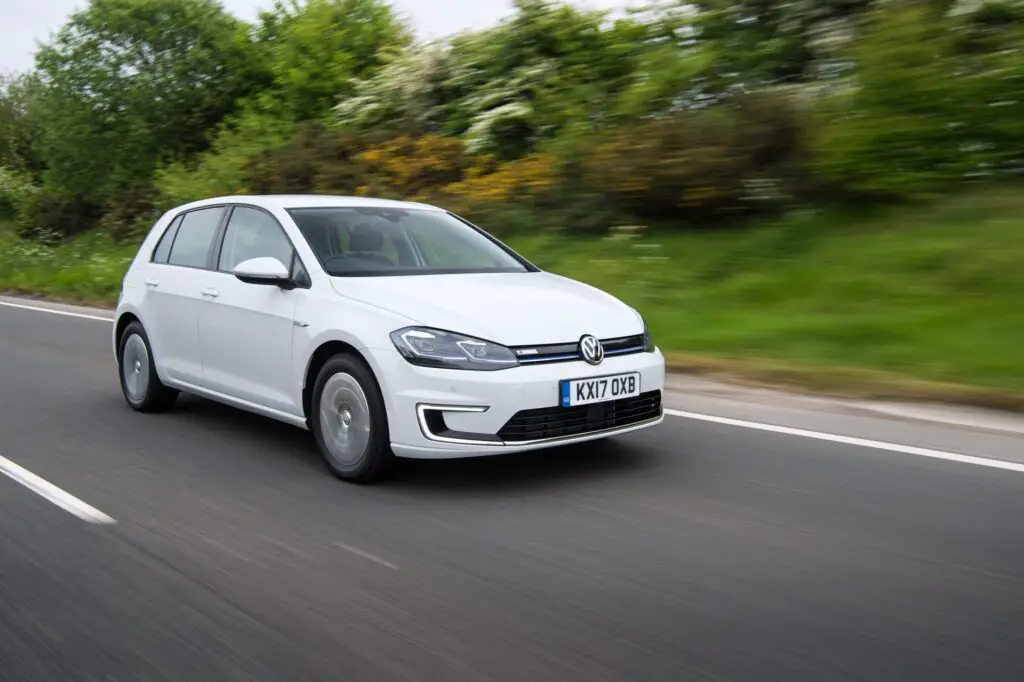
As you’d expect from most German marques, interior quality is outstanding, and there’s little difference between this and a conventional Golf. It’s the same on the road, too.
The ride is refined with solid damping, and with such a low centre of gravity, you can drop the car into a corner and slingshot through the exit using the slugs of torque available. The brakes are equally as impressive but can be difficult to modulate thanks to the insertion of regenerative braking. This is something to get used to, but VW, being the friendly lot they are, has offered you an alternative.
Flick the gearstick to the left or right and you can adjust the amount of natural regen. This being, when you take your foot off the accelerator, the car will automatically brake for you. This comes in surprisingly handy on city roads and can keep that battery topped up in stop-start traffic. Every little helps, as they say.
Out on the open road, though, this car will fly to 93mph. Not overly fast compared to other cars destined for the German Autobahn, but plenty enough to grab you a speeding ticket on a UK road.
Safety and Technology
This is the part where I’d tell you about all the cruise settings and climate control, but we all know what tech a Golf comes standard with. So instead of me telling you about how you can link any phone to the dash, enjoy fully adjustable seating up front, and be safe in the fact that it has enough sensors and assists to make any journey feel like an Italian siesta, I’ll instead talk you through how to live with an electric car.
Firstly, there’s much less to go wrong. In the whole powertrain there are only three moving parts. There’s no oil and no spark plugs, and what servicing does need to be carried out is available through any VW dealer.
Now, the scary bit: charging. It takes only 45 minutes to charge the battery to 80%, and there are charging points all over the country. Use something like Zapmaps to find one local to you. Oh, and to fill it up, it only costs a fiver (typical cost of 14p/KWh). Most owners will be able to charge their EVs at the local supermarket, or you can install a home charger from £279, which includes a government grant of £500.
To Sum Up
There are multiple reasons as to why you’d make the jump to the world of AC and DC. It’s more eco-friendly (depending on where you get your electricity), it’s cheaper to run, and the low-speed performance is hard to match.
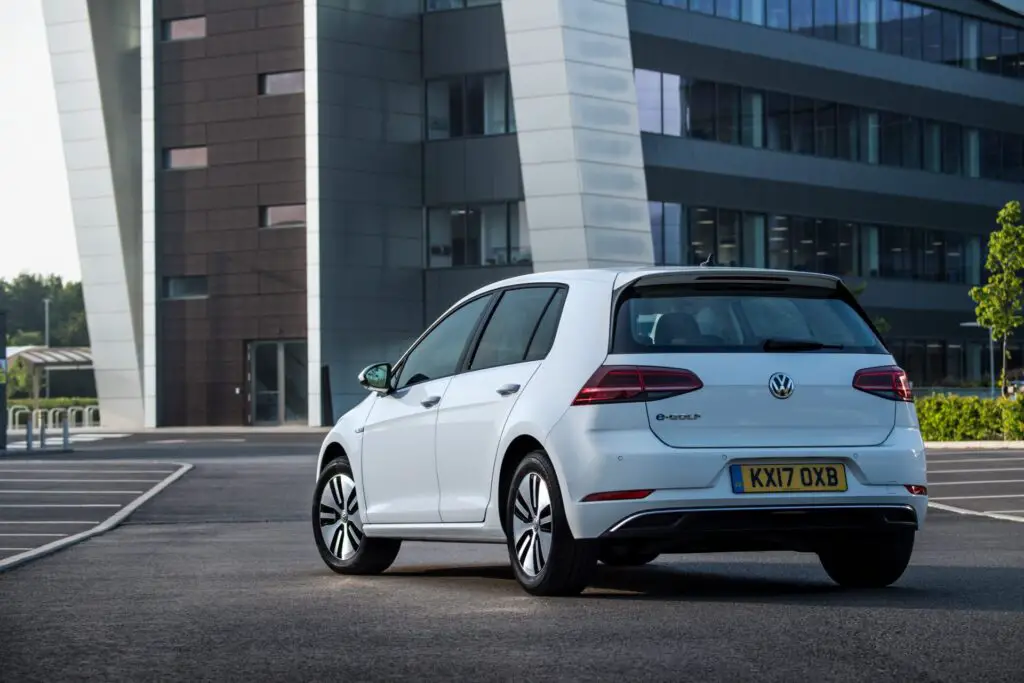
The e-Golf contains all of this within a tight hatchback package while keeping the standout quality and premium dynamics of its engined sibling accounted for. And for some who may question the technology behind an EV, having the backing of the largest automaker in the world always comes in handy.
So, if you’re looking for an EV that feels and drives like not just a car, but one of the best cars on the market, then the e-Golf is certainly for you. But the fact alone that it doesn’t look like something made by Pixar does it for me.
Prices start at £28,690 which includes the £3,500 government grant.